
How Much Does It Cost to Make a Custom Charger?
Our real prices per model, what your logo, box and colour add, and when it's worth paying for a completely new design.
Ask how much it costs to make a custom charger and you'll get answers from two very different worlds. Promotional gift suppliers will sell you 50 logo chargers for an event. Factories will make you 500 or 5,000 chargers to sell under your own brand. The price per piece is nothing alike, and neither is what you get.
We're a charger factory in Dongguan, so this guide uses our own current prices and terms. Where a cost depends on your project and we can't give an honest figure in advance, we say so instead of guessing.
Three ways to get a custom charger
| Promotional merchandise | Private label (OEM) | New design (ODM) | |
|---|---|---|---|
| Typical quantity | 25 to 100 pieces | From 500 pieces per model | From 5,000 pieces |
| What's custom | Logo print | Logo, colour, plug, box | Housing, ports, wattage, charging settings |
| Unit price | Highest | Factory price | Factory price, plus development |
| One-off costs | Usually none | None for the logo | Mould, engineering, certification |
| Good for | Giveaways, events, staff kits | Launching or growing a charger brand | A product nobody else sells |
The promotional route is easy to price because the catalogues list it. UK supplier Pellacraft, for example, lists a branded 65W GaN plug from £18.59, and EU supplier higift lists a 20W USB-C charger at €9.75 a piece for 25 pieces. Those prices include printing and service for small batches, which is fine for a trade show. If you plan to sell chargers, though, they leave no room for a margin.
The rest of this guide is about the second and third routes: getting chargers made under your brand by a factory.
What the charger itself costs
With private label, you choose one of the factory's existing models, which already has its mould, electronics and certificates, and the factory builds it with your branding. So the biggest part of the cost is simply the price of that model. Here are our current prices per piece, for the charger only:
| Model | Price per piece (US$) |
|---|---|
| XPD-V30 30W | 2.92 to 3.23 (1,000 to 3,000 pcs) |
| XFC 30W | 3.38 to 3.92 |
| XFC 35W | 3.46 to 4.08 |
| XFC, BK, FB, HK 65W | 4.92 to 6.92 |
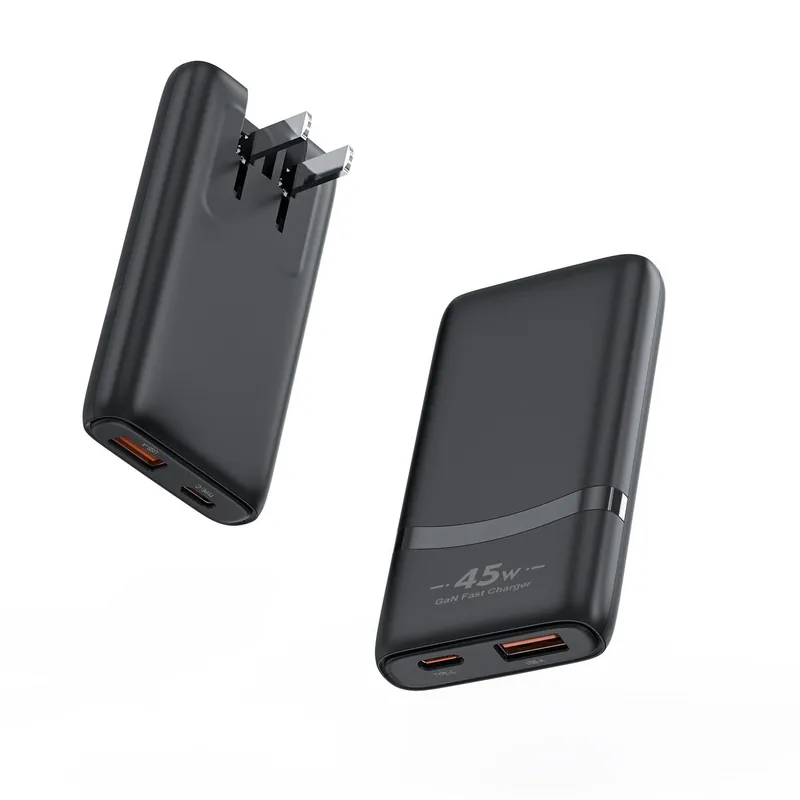
| CB 45W / 65W ultra-thin | 5.38 to 6.46 |
| RJ502 65W, built-in cable | 8.46 to 9.08 |
| MB 100W | 9.08 to 11.23 |
| ZC504 140W | 16.62 to 17.08 |
Prices updated October 2026; your quotation confirms the final figure. Two things move the price within each range:
- Quantity. Prices step down at 500, 1,000 and 3,000 pieces, by roughly US$0.15 a piece at each step. On the XFC 65W, that's the difference between US$5.69 and US$5.08.
- Plug. US and Chinese plug versions are the cheapest. EU and UK plugs cost a little more, because the plug itself is bigger and has more parts.
Wattage and port count drive the rest. A two-port 65W costs more than a one-port 65W, and a 140W needs a much bigger power stage than either. If you're not sure which wattage you need, our GaN vs silicon guide explains what changes as power goes up.
What your logo, box and colour add
This is the part most buyers ask about when they want to know how much it costs to make a custom charger, and it's simpler than many expect.
| Custom option | Minimum | Cost |
|---|---|---|
| Your logo, printed or laser engraved | 500 pcs | No setup or tooling fee; free mockup |
| Plug type (US, EU, UK, AU, CN) | 500 pcs per plug version | Part of the unit price |
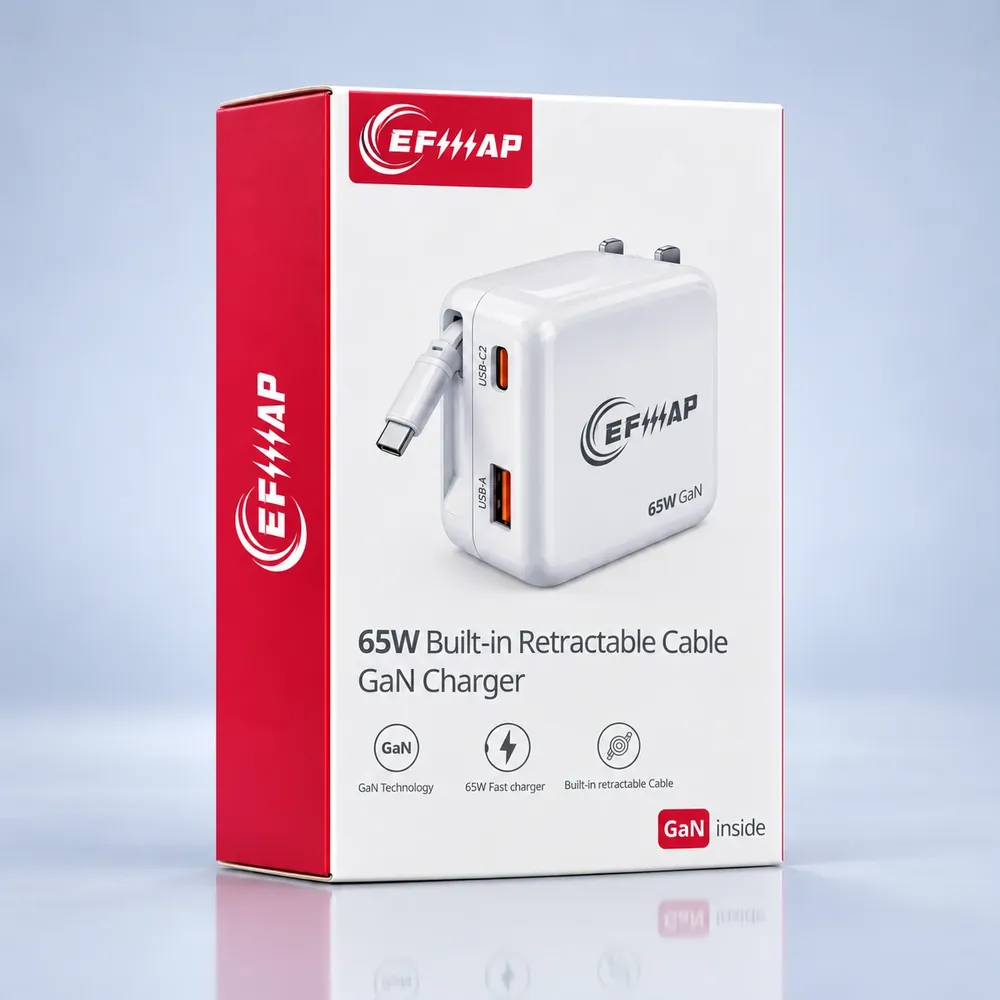
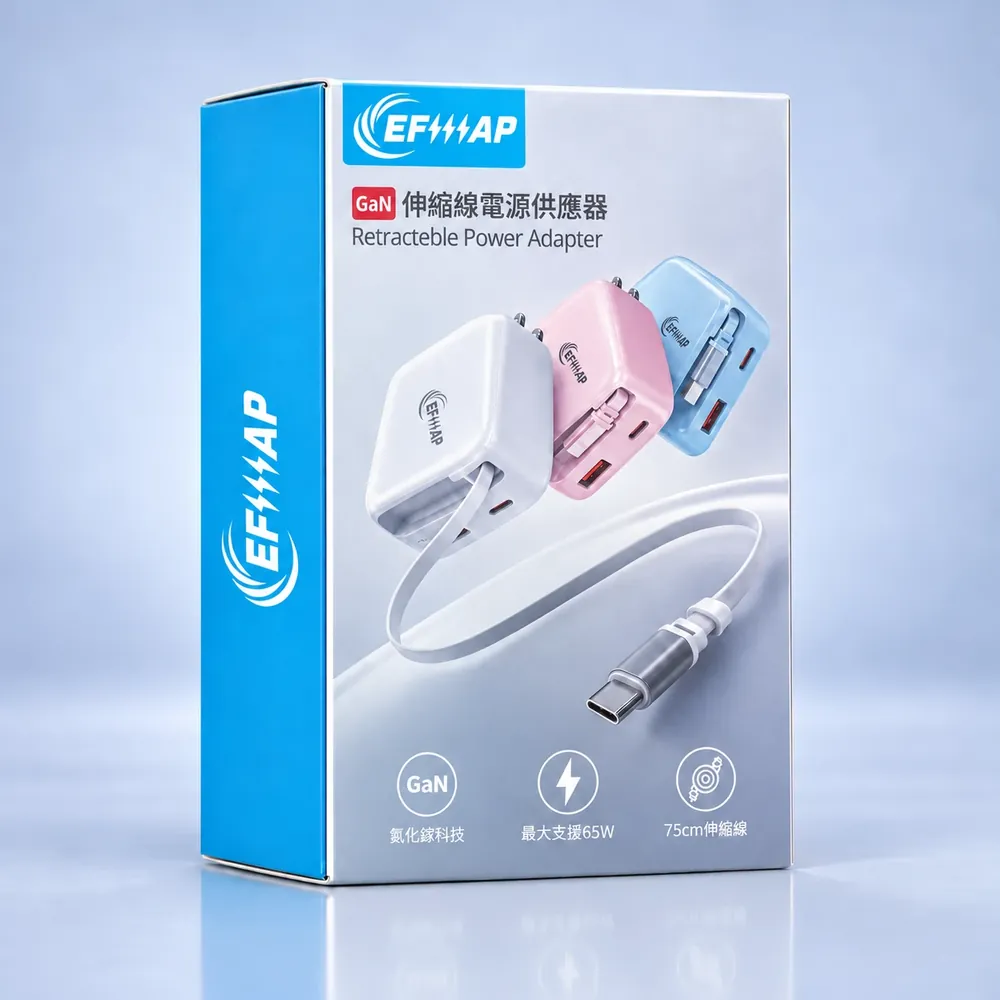
| Printed retail box, 2 styles, with manual | 1,000 pcs | Extra per piece, quoted with your order |
| Custom housing colour (Pantone) | 1,000 pcs | Extra charge at 1,000; free from 3,000 |
| Sample with your logo | 1 pc per model, up to 2 models | Free; you pay the shipping |
Why does the box need 1,000 pieces? Because it's printed in a run, and the plates and setup cost the same whether the printer makes 300 boxes or 3,000. The colour minimum is similar: the plastic is coloured in a batch. Your logo doesn't have that problem, so it starts at 500.
We don't publish a fixed box price because it genuinely depends on what you choose. The UV-printed box has a glossy, scratch-resistant finish for a flagship look; the non-UV box has a matte finish and costs less. Tell us the style and we'll put the exact figure in your quotation.
A worked example: three models, 1,500 pieces
Here's how a new brand could start with three models, using our US-plug prices at the 500-piece step, charger only:
| Model | Quantity | Unit price | Subtotal |
|---|---|---|---|
| XFC 30W, 1 USB-C | 500 | US$3.69 | US$1,845 |
| FB 65W, USB-C + USB-A | 500 | US$5.54 | US$2,770 |
| CB 65W ultra-thin II, 1 USB-C | 500 | US$6.46 | US$3,230 |
| Total | 1,500 | US$7,845 |
Your logo is on all three, with no setup fee. The first order ships without a printed box: in bulk, packed in strips, or in a plain white box on request. When one model sells best, the reorder at 1,000 pieces brings the FB 65W down to US$5.38 and lets you add your own retail box. At 3,000 pieces, a custom housing colour costs nothing extra.
Shipping, import duty, the retail box and plug adapters are not in this example. The next sections cover them.
When a new design is worth it
A new design, or ODM, means the factory develops a charger just for you: your own housing shape, port layout, wattage or charging settings. Three things make it more expensive than private label:
- The mould. A new housing needs new injection-moulding tools. Their cost depends on the shape and the number of parts.
- Engineering. New circuits, firmware settings and samples take engineering time, and the first samples usually need changes.
- Certification. A new design needs its own safety and EMC testing for each market. Existing models already have their reports.
Because these depend on what you want, we quote them per project after an NDA, and our ODM minimum is 5,000 pieces so the one-off costs are spread over a meaningful run. If you'd like a head start, our ODM design catalogue has partly developed designs that can be adapted, which is often quicker than starting from a blank page.
Our honest advice for most new brands: start with private label on an existing model, learn what sells, then move to your own design once you know the volume is there. OEM vs ODM chargers and how to design a custom charger go into more detail.
Costs that aren't on the factory invoice
The factory price is only part of what a custom charger costs you by the time it's on sale. Budget for these too:
| Cost | What drives it | Guide |
|---|---|---|
| Freight | Air, express or sea; weight and volume; destination | DDP vs FOB |
| Import duty and VAT | Your country and the product code | Import duty on chargers |
| Compliance in your name | Your market's rules; what the factory's reports already cover | EU / USA |
| Pre-shipment inspection | Optional third-party inspector | Quality inspection |
| Marketplace fees and labels | Amazon fees, FNSKU labels, prep | Selling on Amazon |
| Trademark | Countries where you register | Starting a brand |
We don't put figures on these here because they vary too much by country, carrier and season to be useful in an article. Your forwarder, customs broker and test lab will quote the real numbers, and it's worth getting those quotes before you decide on a retail price.
Payment terms affect your cash flow, not the price: we work on 50% deposit and 50% before shipment. Production for 1,000 pieces takes about 10 to 15 days after the deposit and sample approval.
How to keep the cost down
- Use an existing model. No mould, no engineering and existing test reports. This is the biggest saving by far.
- Start without a printed box. Launch with 500 pieces in plain packaging, then add your box on the 1,000-piece reorder.
- Stay with black or white until you reach 3,000 pieces, when a custom colour is free.
- Order to the next price step when you're close to it. Going from 900 to 1,000 pieces can cost less per piece than you'd expect.
- Pick the plug you actually need. If you sell in one market, one plug version keeps the order simple. For several markets, an interchangeable-plug model like our ultra-thin range may be easier.
- Test the free sample properly before you order. Finding a problem at sample stage costs nothing; finding it in 1,000 pieces costs a lot.
What you get for the price
Comparing quotes only makes sense if the factories are quoting the same thing. With ours, every charger is hi-pot and aging tested, any unit that fails is repaired and retested on the spot, and the outgoing inspection uses AQL 0 for critical defects, 0.65 for major and 1.5 for minor. You get the inspection report with the order, and our chargers carry a 24-month warranty. If another quote is much lower, ask what testing and warranty it includes.
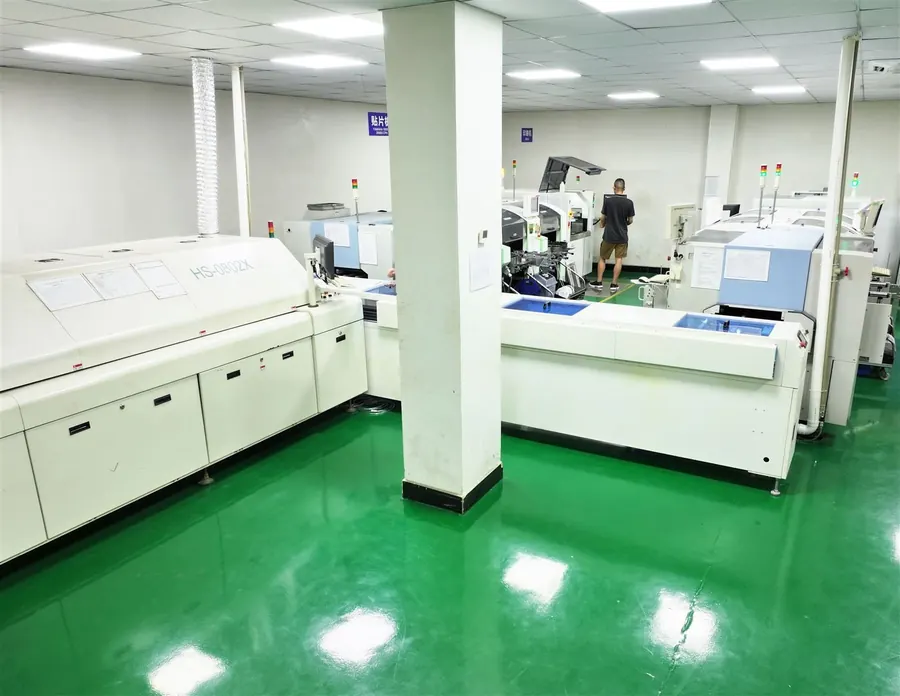
 How our private label chargers are made
FAQ: how much does it cost to make a custom charger
How much does it cost to make a custom charger?
What is the minimum order for a custom charger?
Is there a fee for putting my logo on the charger?
How much does a custom retail box cost?
How much does a custom colour cost?
How much does it cost to design a completely new charger?
Does the price drop with quantity?
Is the sample free?
Why are promotional branded chargers so much more expensive per piece?
Want an exact price for your charger?
Tell us the model, plug, quantity and whether you want a retail box. We'll reply within 24 hours with a quotation and a free sample.
Get a quoteMore from the Rongjun buyer's library
Private label USB-C chargers
Your logo, your box, your colours: how our private label service works.
GaN charger low MOQ
Every model from 500 pieces, with a free sample in three days.
How to negotiate MOQ
Why factories set minimums, and how to start smaller without paying more.