What Certifications Do Chargers Need for Europe?
CE is only the start. Here is the full list for a USB-C wall charger sold in the EU, what each item really involves, who is responsible for it, and the new rules that arrive in December 2028.
Ask ten suppliers what certifications do chargers need for Europe and most will answer "CE" and stop there. That answer isn't wrong, but it leaves out half the list, and it's the half that tends to cause trouble at customs or on Amazon.
We make USB-C chargers at Rongjun and sell a large share of them into Europe, so this list is the one we go through with every European buyer. I've also read the guides that currently rank for this question. Some are good, and a couple contain mistakes that could cost you, so I'll point those out near the end.
What certifications do chargers need for Europe? The short answer
For a mains USB charger sold in the EU you need:
- CE marking under the Low Voltage Directive and the EMC Directive, backed by test reports.
- RoHS compliance, and REACH information if a listed substance is present.
- Ecodesign compliance for external power supplies (efficiency, no-load power, nameplate information).
- A Declaration of Conformity and a technical file.
- The importer's name and address on the product or packaging, and a responsible person in the EU under GPSR.
- WEEE and packaging registration in each country where you sell.
CE: two directives behind one mark
For a charger, the CE mark covers two directives.
- Low Voltage Directive 2014/35/EU covers electrical safety for equipment running between 50 and 1,000 V AC. A wall charger plugged into 230 V is squarely inside it.
- EMC Directive 2014/30/EU makes sure the charger doesn't disturb other equipment and isn't disturbed itself.
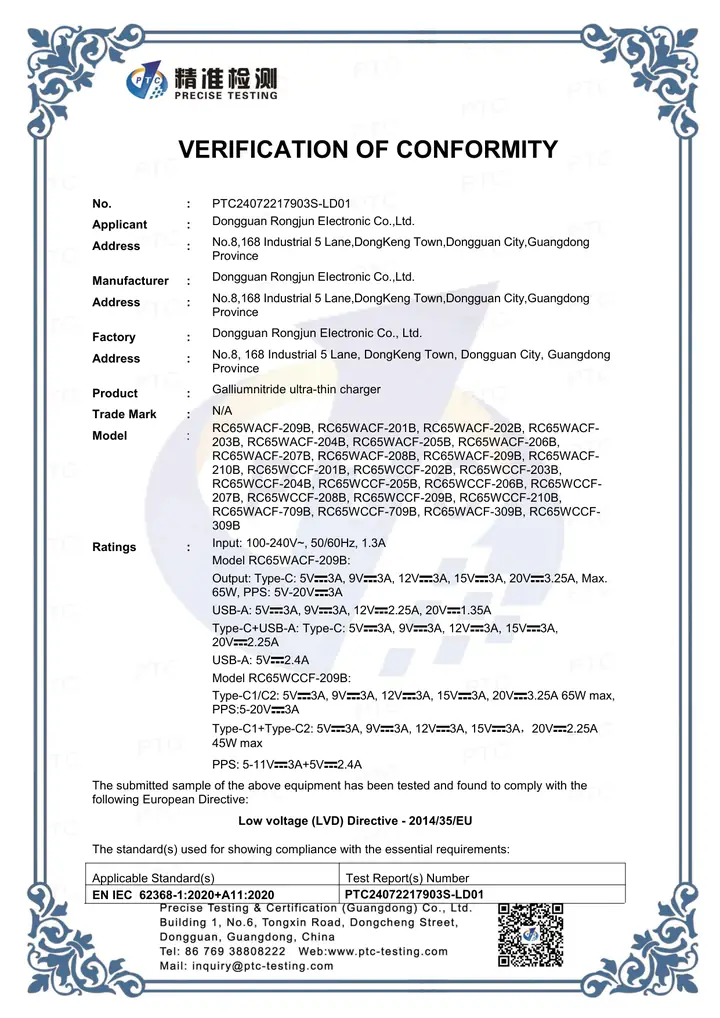
CE for chargers is a self-declaration. Nobody in Brussels issues a "CE certificate" for a phone charger. The manufacturer tests the product, usually at an accredited lab, keeps a technical file, and signs a Declaration of Conformity. That's why the useful thing to ask a supplier for isn't a "CE certificate" but the test reports for the exact model. Ours carry our own name as applicant and manufacturer; you can see them on our certifications page.
What the tests actually check
Safety: EN IEC 62368-1
This standard replaced EN 60950-1 for IT and audio-visual equipment. It works by looking at energy sources (electrical, thermal, fire, mechanical) and checking there are safeguards against each. On a charger the lab looks at things like insulation between the mains side and the USB side, touch current, temperatures under full load, behaviour when the output is shorted or overloaded, and how the housing material behaves with heat and flame. KYT Chargers' guide lists typical pass criteria, such as touch current below 0.5 mA and automatic shutdown on a short circuit.
EMC: emissions and immunity
EN 55032 measures what the charger emits, both back down the mains cable and through the air, against the Class B limits for homes. EN 55035 checks immunity: static discharge, radio fields, fast transients, surges and voltage dips. Because a charger is mains-connected, the EMC test package normally also includes EN IEC 61000-3-2 (harmonic currents) and EN 61000-3-3 (flicker).
GaN chargers switch faster than older silicon designs, which makes EMC filtering more important. It's one reason two chargers that look identical on the outside can behave very differently in an EMC lab.

RoHS and REACH
RoHS (Directive 2011/65/EU, extended by 2015/863) limits ten substances in electrical equipment: lead, mercury, cadmium, hexavalent chromium, two groups of brominated flame retardants and four phthalates. Your supplier should have a RoHS test report for the model.
REACH is broader. If any part of the product contains a substance on the candidate list (the "SVHC" list) above 0.1% by weight, you have to pass that information on to customers. For a well-made charger that usually isn't an issue, but it's a fair question to ask.
Ecodesign: the rule most guides miss
None of the top-ranking guides I read mention this, and it applies to every phone and laptop charger. Regulation (EU) 2019/1782 sets ecodesign requirements for external power supplies: a minimum average efficiency, a maximum power draw when nothing is plugged in, and specific information on the nameplate and in the technical documentation. It's part of what the CE mark on a charger declares.
Ask your supplier for the ecodesign data (average active efficiency and no-load power) for the model you're buying, and make sure the nameplate information is there. It's an easy item to forget until a market surveillance authority asks.
The documents and the labels
- Test reports (safety, EMC, RoHS) for the exact model.
- Technical file: drawings, parts list, test reports, risk assessment. The manufacturer keeps it; the importer must be able to provide it on request.
- EU Declaration of Conformity listing the directives, regulations and standards, signed by the manufacturer. Importers keep a copy for 10 years.
- On the charger: CE mark, model, rated input and output, manufacturer identification, and the WEEE crossed-out bin symbol.
- On the charger or packaging: the importer's name, registered trade name and postal address.
- Instructions and safety information in the language of the country where it's sold.
GPSR: a responsible person in the EU
The General Product Safety Regulation (EU) 2023/988 has applied since 13 December 2024. For consumer products it requires an economic operator established in the EU who is responsible for the product, with their name and contact details on the product, the packaging or an accompanying document.
A factory in China can't fill that role. If you import, it's usually you. If you sell from outside the EU, it can be an EU importer, an authorised representative or a fulfilment service provider. Give us the details and we print them on your box or label.
Country registrations: WEEE and packaging
CE gets the charger into the EU. Each country then has its own take-back schemes for electrical waste and packaging. These are registrations by the company that puts the product on that market, which is normally the importer or brand.
| Country | Electrical waste (WEEE) | Packaging |
|---|---|---|
| Germany | stiftung EAR (ElektroG) | LUCID register (VerpackG) and a licensing scheme |
| France | Producer registration with an approved scheme | Triman logo and sorting info on pack, EPR registration |
| Other EU countries | National WEEE register | National packaging scheme |
The EU's new Packaging and Packaging Waste Regulation started to apply in August 2026, and its labelling rules are being phased in. If you're designing a retail box now, ask your compliance adviser which packaging marks to plan for. Whatever registration numbers and marks you need, send them to us with your artwork and we'll print them.
Selling in Great Britain
The UK government has extended recognition of CE marking for most product rules, including electrical safety and EMC. A correctly CE-marked charger can be sold in Great Britain without UKCA. Merryking's guide says UKCA is required in the UK; for chargers, that's no longer the case. You still need the importer's details on the product or packaging, and the UK has its own WEEE and packaging producer obligations.
What changes in December 2028
This is the part almost nobody is talking about yet. The European Commission adopted Regulation (EU) 2025/2052 in October 2025, with new ecodesign rules for external power supplies. It applies from 14 December 2028. According to the Commission's common charger page, the main points are:
- chargers for radio equipment must be "common chargers", with at least one USB Type-C port;
- common chargers and cables must meet the USB Type-C standards;
- common chargers must work with detachable cables;
- each port must be marked with the power it supports;
- a new EU common charger logo must be applied.
If you're planning a range for 2028 and beyond, these points matter now. Chargers with a cable fixed to the body, or ports without power markings, will need a closer look before then. If you're planning a range that will still be on sale after December 2028, raise it with your supplier now rather than in 2028.
Don't confuse this with the common charger rules that started in December 2024. Those apply to devices (phones, tablets, laptops and so on), which must use USB-C and USB Power Delivery and can be sold without a charger in the box. Our EU common charger guide covers that side.
Checking a supplier's EU documents in ten minutes
Once you know what certifications do chargers need for Europe, checking a supplier is quick. Ask for these four things and look at them side by side:
- The safety test report (EN IEC 62368-1). Look at the first pages: lab name, report number, applicant, manufacturer, model numbers covered, and the ratings. The model and ratings must match the charger you're buying.
- The EMC test report. Same checks. The model list should match the safety report.
- The RoHS report. It should name the same product, not just "plastic parts" in general.
- The Declaration of Conformity. It should list the LVD, EMC, RoHS and ecodesign rules, the standards from the reports, the manufacturer's name and address, and a signature with a date.
If the names on the reports don't match the company you're paying, or the model on the report isn't your model, stop and ask why. If a report looks doubtful, email the lab with the report number; labs will confirm whether a report is genuine. And when you change something later, such as a different housing material or a new circuit board, ask whether the reports still cover it.
Three things other guides get wrong
"Plain chargers need the Radio Equipment Directive"
KYT's guide lists RED among the directives for phone chargers. A plain mains charger has no radio, so it falls under LVD and EMC. RED applies if the charger has a radio function, such as a wireless charging pad or Bluetooth. The common charger rules live in RED, but they're aimed at the devices being charged.
"The technical file goes to a notified body"
Merryking's guide describes submitting the file to a notified body. For chargers under LVD and EMC there's no notified body step. Accredited labs do the testing; the manufacturer declares conformity.
"Spot the fake 'China Export' mark"
You'll read that a "China Export" logo with the C and E closer together is a separate fake mark. Whatever the spacing, a CE mark without matching test reports and a Declaration of Conformity is worthless, and a correctly proportioned one without them is worthless too. Check the paperwork, not the font.
Who does what
| Item | Factory | Importer / brand |
|---|---|---|
| Safety, EMC and RoHS testing | Yes (reports in our name) | Check they cover your model |
| CE mark and nameplate on the charger | Yes | Check before shipment |
| Declaration of Conformity | Signed by the manufacturer | Keep a copy for 10 years |
| Importer details on product or box | Prints them | Supplies them |
| GPSR responsible person | Prints the details | Is (or appoints) the person |
| WEEE and packaging registration | Prints marks and numbers | Registers in each country |
If you'd like to see where the tested chargers are actually built, here's a short look at our factory.
 Where our CE-tested chargers are made, 29 seconds
FAQ: certifications chargers need for Europe
What certifications do chargers need for Europe?
Is CE marking a certificate?
Do USB chargers need the Radio Equipment Directive?
Does a charger need a notified body in the EU?
What is the ecodesign regulation for chargers?
Do I need UKCA to sell chargers in the UK?
Who has to register for WEEE?
Can I use the factory's test reports?
What is GPSR and does it apply to chargers?
Are there extra rules for Germany or France?
Need chargers that are ready for Europe?
Tell us the model and the countries you sell in. We'll send the test reports in our name and tell you which marks and details we need from you for the box.
Get a quote