GaN vs Silicon Charger: What Really Changes Inside
From a factory that makes both: what gallium nitride changes, what it doesn't, real dimensions from our own range, and when silicon is still the sensible choice.
Most GaN vs silicon charger comparisons are written by brands selling GaN chargers, so they tend to make GaN sound better at everything. It's better at a lot, but not everything, and two of the most common claims are simply wrong.
I'm Chen Jun Liang, and I work in R&D at a charger factory in Dongguan. Our standard range is GaN, from 30 W to 140 W, and we make silicon chargers too when a customer needs them. Here's what actually changes when you swap silicon for gallium nitride.
The short answer
- GaN makes chargers smaller for the same power, and lets them run cooler.
- GaN doesn't make charging faster at the same wattage. Speed comes from power and protocols.
- GaN doesn't decide safety. Design, protection and testing do.
- The bigger the wattage, the bigger the difference. At 100 W and above, GaN is the normal choice.
- Silicon is still fine for low-power chargers where size doesn't matter.
What GaN changes inside a charger
A USB charger takes mains electricity, switches it on and off very quickly, passes it through a small transformer and turns it into a low DC voltage. The switching is done by power transistors. In a traditional charger they're silicon; in a GaN charger, the main one is gallium nitride.
GaN transistors can switch faster, with less energy lost each time they switch. That has a chain of effects:
- Higher switching frequency is practical without the losses climbing too much.
- Smaller magnetic parts. At a higher frequency, the transformer and filter parts can be smaller.
- Less heat. Lower losses mean less heat to get rid of, so the housing can be smaller without the charger getting too hot.
- Room for more ports. The space saved can hold extra ports and their control circuits.
heybmx, a charger brand, sums it up the same way: the charger runs at a higher switching frequency, the magnetics get smaller and efficiency goes up. That's the whole story. Everything else follows from it.
What GaN doesn't change
This is where many comparisons go wrong.
Charging speed
Anker's guide lists "faster charging" as a GaN advantage. At the same wattage, that isn't right. A phone or laptop charges as fast as the charger's power and protocols allow, and as fast as the device asks for. A 65 W GaN charger and a 65 W silicon charger with the same USB PD and PPS support charge at the same speed. heybmx says this clearly, and it's correct. GaN lets you get more watts in a small charger; it doesn't make each watt faster.
Protocols
SmartGear Outlet's comparison table gives GaN chargers wider protocol support, such as PD 3.1 and PPS, than silicon. That's a feature of the charger's controller, not of the transistor material. A silicon charger can support USB PD and PPS, and a GaN charger can lack them. Always read the protocol list on the spec sheet. Our PD vs PPS guide explains what to look for.
Safety
Both GaN and silicon chargers must meet the same safety standards and protections: over-voltage, over-current, over-temperature and short-circuit. GaN's lower heat is a help, but a GaN charger with poor design or no testing isn't safe because of its chip. Check the test reports for the model, whatever it's made of.
Real sizes from our own range
Most articles give general size percentages. Here are actual dimensions from our catalogue, which show what GaN design makes possible:
| Model | Power | Ports | Size (mm) |
|---|---|---|---|
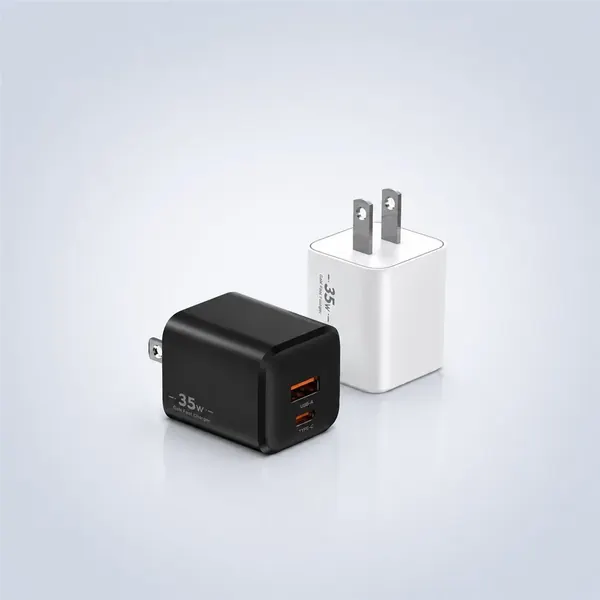
| XFC 30W | 30 W | 1C or C+A | 40 × 34.5 × 32.5 |
| XFC 65W | 65 W | 1C | 40 × 34.8 × 32.8 |
| HK 65W | 65 W | Up to 2C + 1A | 56.4 × 55.6 × 28.6 |
| MB 100W | 100 W | 2C + 1A | 56.4 × 55.6 × 28.6 |
| CB 65W ultra-thin | 65 W | Up to 2C | 84 × 45.5 × 14.6 |
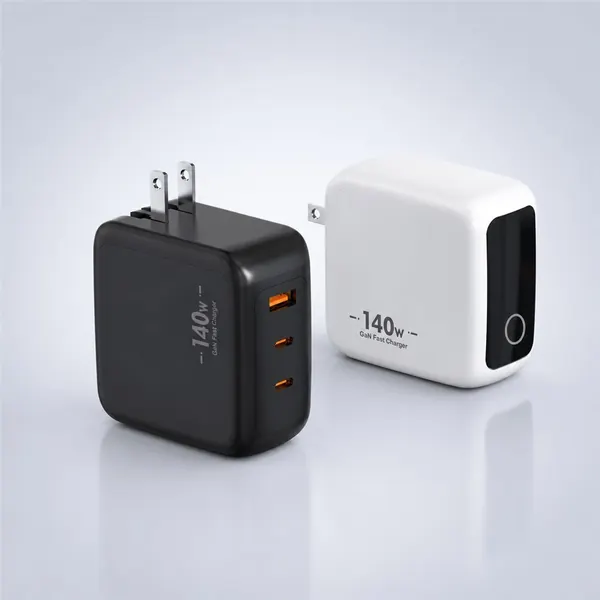
| ZC504 140W | 140 W | 2C + 1A, display | 71 × 71 × 36 |
Two comparisons stand out. Our XFC 65W is practically the same size as our XFC 30W: more than double the power in the same body. And our MB 100W uses the same housing as our three-port HK 65W. That's the GaN advantage in plain numbers: power goes up much faster than size.
The CB 65W shows the other side of it: the space GaN saves can be used for a different shape, in this case a charger under 15 mm thick that slips flat into a laptop bag.
GaN vs silicon side by side
| GaN charger | Silicon charger | |
|---|---|---|
| Size for the same power | Smaller; the gap grows with wattage | Larger |
| Heat | Less | More |
| Charging speed at the same watts | Same | Same |
| Protocols (PD, PPS, QC) | Depends on the controller | Depends on the controller |
| Multi-port at 65 W+ | Easy to fit | Gets bulky |
| 100 W and above | Normal choice | Rarely practical in a portable size |
| Part cost | Higher | Lower |
| Safety standards | Same | Same |
We've deliberately left out exact efficiency, temperature and weight figures. They vary so much from one design to another that a general number isn't useful. If you need them for a specific model, ask for the test data for that model.
When silicon still makes sense
heybmx makes a point many GaN sellers avoid: silicon is not dead. It's a reasonable choice when:
- The power is low. At 5 to 20 W the size difference is small, and a well-made silicon design does the job.
- Size doesn't matter. A charger that lives behind a desk or inside a product doesn't need to be tiny.
- The project is driven by price. Some tenders and bundles care about cost above all, and silicon parts are cheaper.
- It must match an existing design. Sometimes a replacement has to match an older product exactly.
We make silicon chargers on customer demand for exactly these cases. For chargers sold as an upgrade, especially 30 W and above, GaN is what most buyers now expect.
How to check a "GaN" claim
"GaN" on a box is a marketing word as much as a technical one, and there's no label that proves it. If you're buying chargers to sell, these checks help:
- Compare size to power. A 65 W charger the size of an old laptop brick is unlikely to be making much use of GaN.
- Ask which GaN part is used. A real factory can tell you the GaN transistor or integrated chip in the design. A trader often can't.
- Run it at full power. Charge a laptop at the charger's rated wattage for an hour and check how warm the housing gets compared with a similar charger.
- Read the spec sheet, not the box. Look for the power per port, the protocols and the model's test reports.
Three marketing claims to read carefully
- "Charges X times faster." Usually compared with an old 5 W charger, not a silicon charger of the same wattage. The speed comes from the wattage and USB PD, not from GaN.
- "GaN III" or "GaN 5". These are brand names for generations of chips or designs, not industry standards. They don't tell you much on their own; the size, power and test data do.
- Exact percentages. Claims like "50% smaller" or a precise efficiency figure depend on which two chargers are compared. Ask for the measured data for the model you're buying.
For brands: which to choose
| Your product | Our suggestion |
|---|---|
| Phone charger, 20 to 35 W, sold as a compact upgrade | GaN, e.g. XFC 30W from US$3.38 |
| Phone + laptop charger, 65 W | GaN; silicon would be noticeably bigger |
| Multi-port 65 to 100 W | GaN, e.g. MB 100W from US$9.08 |
| 140 W laptop charger | GaN, e.g. ZC504 from US$16.62 |
| Low-power charger in a bundle, size not important | Silicon may be enough; ask us |
Prices are per piece for the charger, depending on quantity and plug, from 500 pieces per model with your logo. Whichever you choose, the things that decide whether customers are happy are the same: the right wattage and protocols for their devices, good testing, and a warranty you can stand behind. With us, every charger is hi-pot and aging tested, failed units are repaired and retested on the spot, and the warranty is 24 months.
 Inside our GaN charger production
FAQ: GaN vs silicon charger
What is the difference between a GaN and a silicon charger?
Does a GaN charger charge faster than a silicon charger?
Are GaN chargers safer than silicon chargers?
Is a GaN charger worth it?
Do GaN chargers last longer?
Why are GaN chargers more expensive?
Do you make silicon chargers?
Can a GaN charger damage my phone?
GaN or silicon for your range?
Tell us the wattage, ports and market. We'll tell you honestly which makes sense, and send samples to compare.
Get a quote