Charger Certification Requirements USA: FCC, UL, DOE
For USB-C phone and laptop wall chargers: what the law requires (FCC and energy efficiency), what retailers require (UL or ETL listing), and the difference between a listing and a test report.
Search Google for "charger certification requirements USA" and nearly every result is about electric-vehicle charging stations. If you're importing USB-C wall chargers for phones and laptops, the rules are different and simpler, but there's one distinction that trips people up: what the law requires, and what the people who sell your chargers require.
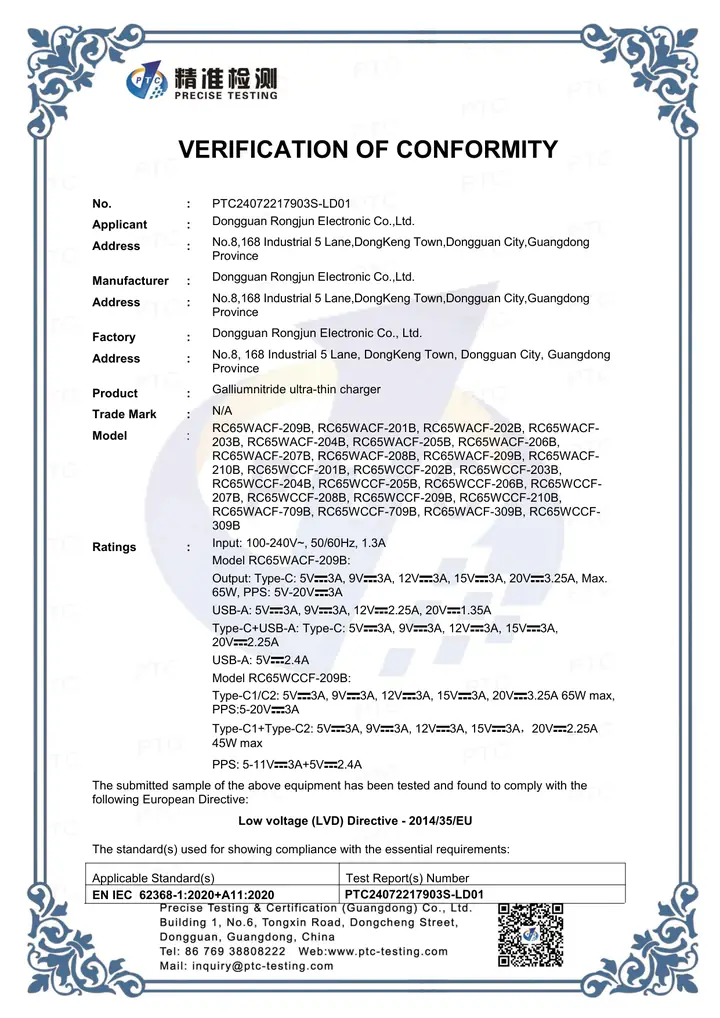
We make chargers at Rongjun in Dongguan, including US-plug versions, and we get asked about this regularly. Here's the honest version of the charger certification requirements in the USA, including where our own documents stand.
Not EV chargers: what this guide covers
This guide is about mains-powered USB chargers: the small adapters that plug into a 120 V outlet and charge phones, tablets and laptops through USB-C or USB-A. Electric-vehicle chargers, battery packs and power banks have their own rules and aren't covered here.
The short list
| Requirement | Legal or commercial? | What it covers |
|---|---|---|
| FCC Part 15 | Legal | Radio interference from the charger's electronics |
| DOE efficiency (external power supplies) | Legal | Efficiency and no-load power; efficiency mark on the label |
| California appliance efficiency listing | Legal, for sale in California | Listing in the California Energy Commission database |
| UL or ETL listing to UL 62368-1 | Mostly commercial | Electrical safety, with follow-up factory inspections |
| California Prop 65 | Legal, if a listed chemical is present | Warning labels |
imiapower's guide gives the same three for the US: FCC Part 15 Class B, UL or ETL listing, and DOE/CEC efficiency. Below is what each one actually involves.
FCC Part 15: required for every mains charger
A charger doesn't transmit radio on purpose, but its switching circuit runs at high frequency and can leak interference onto the mains wiring and into the air. That makes it an "unintentional radiator" under FCC Part 15. Consumer chargers have to meet the Class B limits for residential use.
For most chargers, the route is the Supplier's Declaration of Conformity: the product is tested, the responsible party in the US keeps the test records and issues the declaration, and the product carries the required compliance information. You don't usually need an FCC ID for a plain wall charger; that's for products that transmit, such as wireless chargers with radio functions.
Note the "responsible party in the US" part. For an imported charger, that's typically the importer or brand. The factory provides the test report; you hold the declaration.
Energy efficiency: DOE and California
The Department of Energy regulates external power supplies, which includes phone and laptop chargers. The current standard, known as Level VI, sets a minimum average efficiency when working and a maximum power draw when nothing is plugged in. Compliant power supplies carry the efficiency mark (a Roman numeral VI) on the label.
California goes further: its Energy Commission maintains a database of appliances that may be sold in the state, and power supplies are among them. If you sell in California, which most national sellers do, the product needs to be listed.
Efficiency depends on the design, so this is a question for the factory per model. Ask for the efficiency test data and check the label before production. GaN designs tend to make efficiency easier to achieve, but the data is what counts.
Safety: UL or ETL listing
This is where law and practice diverge. There isn't a single federal rule that every consumer charger must be UL listed. But:
- major retailers and many distributors require a listing from a nationally recognised testing laboratory (NRTL), such as UL or Intertek's ETL;
- marketplaces ask for safety documentation and many sellers find a listing is the smoothest way to provide it;
- equipment used in workplaces is expected to be NRTL-listed;
- insurers and product liability claims look at it.
imiapower puts it well: UL or ETL is "often required by distributors and e-commerce platforms", and testing may be needed even if the charger already has CE. Both UL and ETL list chargers to the same standard, UL 62368-1, so a retailer that asks for "UL or equivalent" accepts ETL.
"UL listed" vs "tested to UL 62368-1"
This is the distinction that causes the most confusion in supplier emails, so it's worth being precise.
| Test report to UL 62368-1 | UL or ETL listing | |
|---|---|---|
| What it is | A lab report showing a sample passed the tests | Certification by the NRTL, with ongoing follow-up |
| Factory inspections | No | Yes, periodic follow-up visits |
| Mark on the product | No listing mark | UL or ETL mark allowed |
| Accepted by big retailers | Usually not on its own | Yes |
A supplier that says "UL certified" but sends a test report is describing the left column, not the right. Ask for the listing file number and check it in the lab's online directory.
To be clear about our own range: our HK 65W carries ETL. Several other models have test reports to the US safety standard, which is a good starting point for a listing but not the same thing. Most of our models have FCC test reports. Our certifications page lists the documents model by model.
California Proposition 65
Prop 65 requires a warning when a product exposes people in California to a listed chemical above a certain level. Whether a charger needs one depends on its materials, and many sellers take advice from a compliance specialist. We don't make Prop 65 claims for our chargers; if you need material information for your assessment, ask us.
What goes on the label
- Model number, input and output ratings.
- FCC compliance information as required for the authorisation route used.
- The DOE efficiency mark.
- The UL or ETL listing mark, if listed.
- Your brand and the responsible party's details, on the product or packaging.
Plan these before production. They're printed on the housing or the label, so they can't be added in a photo afterwards.
Selling in Canada too
Canada uses ISED rules for radio interference (similar to FCC) and requires electrical products to be certified by an accredited body, often shown as cUL or cETL. imiapower notes the same. If you'll sell in both countries, ask for the listing to cover both from the start.
Documents to ask your supplier for
Before you place an order, ask for these by model number, not as a general "we have FCC" statement. Each one should name the exact model you're buying.
- FCC Part 15 test report. From the lab that tested it, showing Class B limits and the model number.
- Efficiency test data. Average active-mode efficiency and no-load power, measured to the DOE test method.
- Safety report or listing. A UL 62368-1 test report, or the UL or ETL listing file number if the model is listed.
- Label artwork. A drawing of the rating label with every mark in place, for you to approve before production.
- Critical components list. The parts that safety testing depends on: transformer, capacitors, fuse, housing material. If these change, the listing may no longer apply.
That last point matters more than most buyers realise. A listing covers the charger as it was built when tested. If the factory swaps a component to save cost, the listed product and the one in your carton are no longer the same. Ask your supplier to confirm in writing that the components won't change without telling you.
Common mistakes we see
- Treating CE as enough. A CE mark means nothing to a US retailer. The test reports behind it can help, because the safety standard is the same family, but the US documents still have to exist.
- Accepting a certificate with someone else's model number. A report for a "similar" charger doesn't cover yours. Check that the model on the report matches the model on the label.
- Leaving the label until last. FCC information and the efficiency mark go on the housing. If they're missing from the mould or label artwork, the batch has to be reworked.
- Forgetting who the responsible party is. For the FCC declaration, the responsible party has to be in the US. If you're a foreign brand, you'll need a US importer or representative to take that role.
- Planning a listing after the order ships. UL and ETL work takes time and includes a factory inspection. Start before production if you need it for launch.
Tariffs: check them separately
Certification and import duty are separate questions. Duties on goods of Chinese origin have changed often and sometimes with little notice, so check the current position with a licensed customs broker before you price an order. We don't quote tariff numbers here because they'd be out of date too quickly.
A checklist before you order US-plug chargers
- FCC Part 15 test report for the exact model.
- DOE efficiency data and the efficiency mark on the label.
- California efficiency listing if you'll sell there.
- UL or ETL listing if you'll sell through retail or need it for Amazon; check the file number.
- Your responsible-party details for the FCC declaration and the packaging.
- Current tariff position from your customs broker.
 Where our US-plug chargers are made
FAQ: charger certification requirements in the USA
What certifications does a USB charger need to sell in the USA?
Is UL certification required for chargers in the US?
What's the difference between UL and ETL?
Does a USB charger need FCC certification?
What is DOE Level VI?
Is a UL test report the same as UL listing?
Which Rongjun chargers are ETL listed?
Do I need Prop 65 warnings on chargers?
Do I need different certifications for Canada?
Can I sell a CE-marked charger in the US?
Selling chargers in the US?
Tell us the models you're considering. We'll send the FCC and safety documents we have for each, and tell you honestly what a UL or ETL listing would involve.
Get a quote