Import Duty on Chargers from China
We looked the rates up on the official tariff rather than repeating what other blogs say. For mains USB chargers the duty is 0% in the UK and the EU; here's what you actually pay, and where the costs really are.
Search for import duty on chargers from China and you'll find a lot of general advice about "electronics" and duty "between 0 and 12 percent". That range is true for goods in general. It isn't much help when you're pricing a container of USB-C chargers.
So we did the boring thing and checked. On 14 October 2026 we looked up the usual charger code on the UK Trade Tariff and on the Northern Ireland tariff, which applies EU rates. Both said the same: 0% duty. I work at Rongjun, a charger factory in Dongguan, and this is the page we now send buyers who ask what they'll pay at the border.
The short answer
| United Kingdom | European Union | |
|---|---|---|
| Commodity code checked | 8504 40 95 90 | 8504 40 95 90 |
| Customs duty from China | 0.00% | 0.00% |
| Extra duties on Chinese origin | None listed | None listed for this code |
| Import VAT | 20% | Rate of the country of clearance (e.g. 19% DE, 21% NL) |
| Low-value parcels | No duty up to £135 | €3 per item up to €150 (from 1 July 2026) |
Checked on trade-tariff.service.gov.uk (UK and Northern Ireland tariffs) on 14 October 2026. Rates change; check again before you price a large order.
The commodity code for chargers
Phone and laptop wall chargers are "static converters": they turn mains AC into low-voltage DC. That puts them under heading 8504 40. The full 10-digit code we checked, 8504 40 95 90, sits under "Static converters › Other › Other › Other".
Two things can change the code. A charger with a battery inside (a power bank with a plug) is a different product for customs and for shipping. And very specialised power supplies, for example ones built into telecom or medical equipment, can sit elsewhere. For a normal USB-C wall charger, 8504 40 is the right heading. Epic Sourcing's UK duty guide gives good advice here: let your broker confirm the code, and if you import often, consider an advance tariff ruling from HMRC for certainty.
UK: duty, VAT and a worked example
With 0% duty, the border cost on a UK charger import is essentially VAT plus the forwarder's fees. VAT is charged on the customs value, which is the price of the goods plus freight and insurance to the UK, plus any duty (here, none).
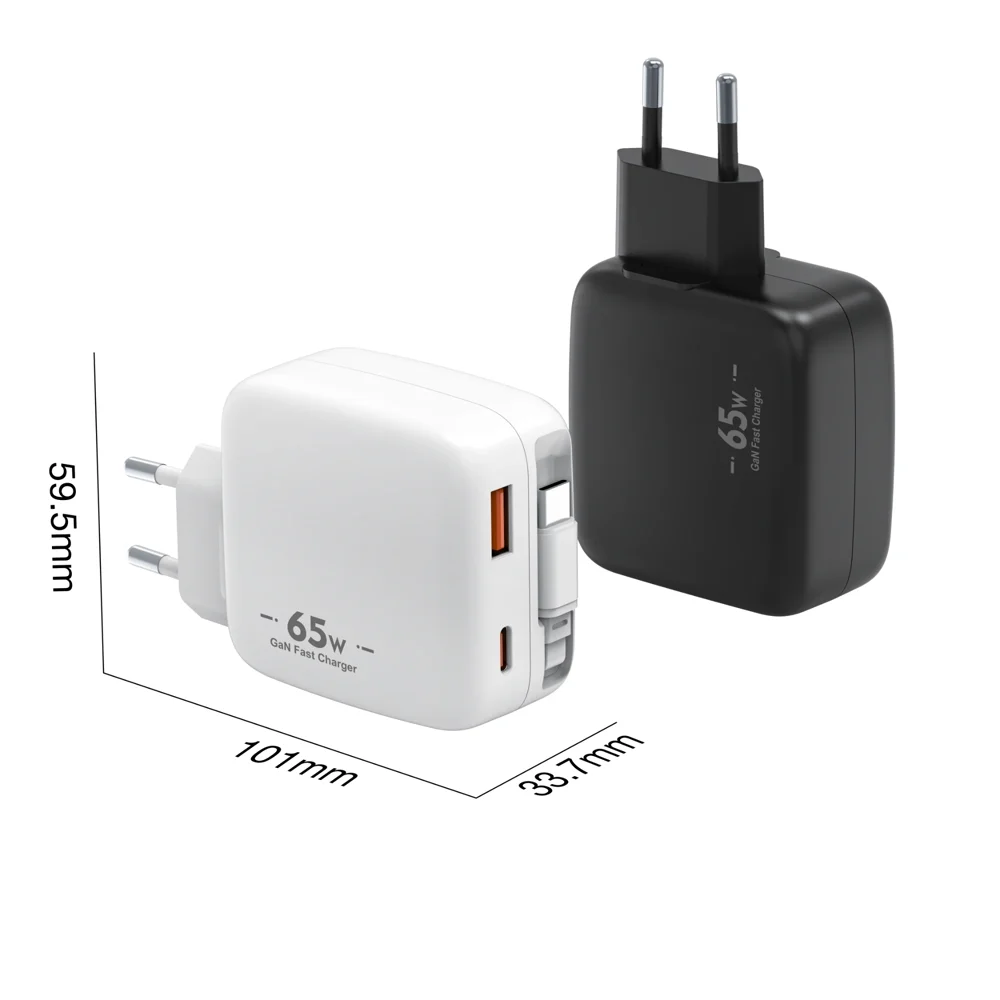
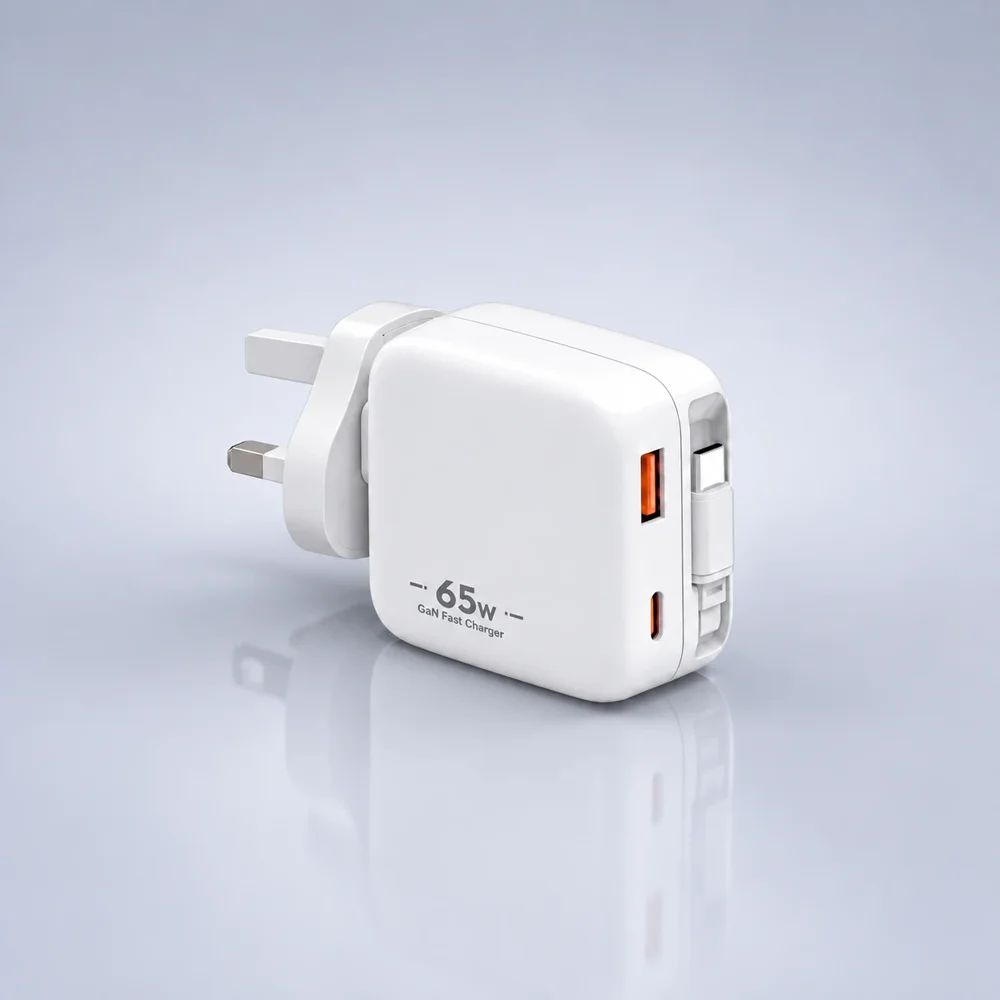
Here's an example with 1,000 of our XFC 65W chargers, which cost US$5.08 to 5.69 a piece depending on quantity and plug. Freight and fee figures are examples only; get real ones from your forwarder.
| Line | Example |
|---|---|
| Goods, 1,000 pcs (converted to pounds) | about £4,200 |
| Freight and insurance to the UK port (example) | £800 |
| Customs value | £5,000 |
| Customs duty at 0.00% | £0 |
| Import VAT at 20% | £1,000 (reclaimable, or postponed) |
| Clearance and delivery (example) | £250 |
For a VAT-registered importer, the real cost in this example is about £5,250, or £5.25 per charger. Compare that with Epic Sourcing's water-bottle example, where 6% duty added a non-reclaimable £144 to a £2,400 shipment. On chargers that line is zero.
What goes into the customs value
Import VAT (and any duty) is worked out on the customs value, not on the factory price. SimplyVAT's EU guide lists what that includes and leaves out, and the UK works the same way in practice:
| Included | Not included |
|---|---|
| The price paid for the chargers | Buying commission you pay your own agent |
| Freight and insurance up to the UK or EU border | Transport after the goods enter the UK or EU |
| Selling commissions, packing costs paid by you | The import VAT and duty themselves |
| Royalties or licence fees tied to the goods | Interest on financing the purchase |
That's why the same chargers can end up with different VAT bills: an EXW purchase adds Chinese inland transport and export costs to the value; a FOB purchase starts at the port. Either way, VAT is then charged on value plus duty, and with 0% duty that simply means on the value.
Paying through a deferment account
If you import regularly, your broker can pay any duty through your own duty deferment account, so charges are collected once a month by direct debit instead of per shipment. With charger duty at 0%, most importers use postponed VAT accounting for the VAT and don't need much more than that.
Postponed VAT: pay nothing at the border
None of the guides I read for this article mention it, and it's one of the most useful tools for UK importers. If you're VAT-registered, you can use postponed VAT accounting: instead of paying import VAT when the goods arrive and reclaiming it weeks later, you declare it on your VAT return and reclaim it on the same return. The cash never leaves your account.
Tell your forwarder you want to use postponed VAT accounting before the goods arrive, and download your monthly postponed import VAT statement from HMRC to complete the return. On a charger import, where VAT is almost the only border cost, this makes a real difference to cash flow.
EU: duty, VAT and the new €3 parcel rule
On the Northern Ireland tariff, which applies EU rates, 8504 40 95 90 showed 0.00% third-country duty on 14 October 2026. For a normal commercial import into the EU, you pay import VAT at the rate of the member state where the goods are cleared, plus your broker's fees.
| Country | Standard VAT |
|---|---|
| Germany | 19% |
| France | 20% |
| Netherlands | 21% |
| Spain | 21% |
| Italy | 22% |
| Poland | 23% |
The €3 low-value rule
From 1 July 2026, parcels worth up to €150 lost their duty exemption. The same tariff page now lists a "low-value consignment customs duty" of €3.00. Stickiply's guide explains how it works: the €3 is charged per customs item, where an item is a combination of tariff code, description and country of origin. Several identical chargers in one parcel count as one item; a charger and a cable in the same parcel count as two. The flat rate is planned to run until 1 July 2028, after which the EU intends to move to a set of percentage bands.
This matters if you sell direct to EU consumers from outside the EU, or if you ship samples. For pallet or container imports above €150, the normal rules apply and the €3 doesn't.
Samples and small parcels
Samples are where most first-time importers meet customs charges, because the courier sends the bill. GOV.UK's parcel rules are simple: in Great Britain, non-excise goods worth £135 or less carry no customs duty, but VAT is due and the courier will usually add a handling fee. In the EU, the €3 per item charge now applies on top of VAT.
Our samples are free (one per model, up to two models), and you pay the courier. We declare samples at their real value. If you think you've been overcharged on a parcel, GOV.UK lists the refund forms: BOR 286 for Royal Mail or Parcelforce, C285 for other couriers.
US, Gulf and other markets
For the United States, check the current position with a licensed customs broker before you order. Tariffs on goods of Chinese origin have changed several times recently, sometimes with very little notice, and an old number from a blog post can be badly wrong.
Most Gulf states apply a common external tariff to imports from outside the region, and import VAT differs by country (Saudi Arabia and the UAE, for example, have different VAT rates). Your clearing agent in the destination country will confirm the duty for your code. Our Middle East and Africa pages cover the certificates those markets ask for.
Can you pay less? Honest options
With 0% duty in the UK and EU, there's nothing to cut on the duty line. These are the things that genuinely lower your landed cost:
- Register for VAT and use postponed VAT accounting in the UK, so import VAT isn't a cost or a cash-flow problem.
- Ship more per consignment. Clearance fees are per shipment, so fewer, larger shipments cost less per charger.
- Think about packaging. Bulk packing in strips takes far less freight space than retail boxes.
- Use the price steps. Our unit price drops about US$0.15 at 1,000 pieces and again at 3,000.
- Buy from the factory, not through a trader, so you don't pay a middle margin on every reorder.
What doesn't work: under-declaring the invoice. Customs can compare declared values with bank payments and market prices, and the importer pays back the difference plus penalties. We always invoice the real price. It's also why we don't sell DDP; our DDP vs FOB guide explains why.
Mistakes that cost importers money
- Using the wrong code. A power bank declared as a charger, or a charger declared under a code with duty, causes delays and corrections.
- Paying VAT you could postpone. Many small UK importers still pay VAT at the border and wait to reclaim it.
- Forgetting the freight in the customs value. VAT is charged on goods plus transport to the border, not on the factory price alone.
- Assuming last year's rate. Tariffs and parcel rules changed in 2026. Check before each big order.
- Mixing many product types in small EU parcels. Under the €3 rule, each different item adds a charge.

 Inside our charger factory, 29 seconds
FAQ: import duty on chargers from China
What is the import duty on chargers from China to the UK?
What is the import duty on chargers from China to the EU?
What HS code do phone chargers use?
Do I pay VAT on chargers imported from China?
What is the €3 EU customs duty?
Is there anti-dumping duty on Chinese chargers?
Do I pay duty on a charger sample?
Who pays the import duty, me or the factory?
Can I avoid import duty on chargers?
Why do some sites say electronics have 3% or more duty?
What is the HS code for a USB charger?
Want a landed-cost estimate for your order?
Tell us the model, quantity and destination. We'll send the factory price, the commodity code on our invoice and the documents your broker will need.
Get a quote