
Factory vs Trading Company China: How to Tell the Difference
Every supplier on Alibaba seems to be a 'manufacturer'. Here is how a charger factory in Dongguan would check one, which signs actually mean something, and when a trading company is honestly the smarter buy.
Picture two quotes for the same 65W charger. Both suppliers call themselves manufacturers. Both have nice photos, fast replies and good reviews. One is about a dollar cheaper. Which one actually makes the charger?
You can usually answer that in an afternoon, without flying to China. The factory vs trading company question in China has a fairly clean answer once you know where to look, and the most useful document is free and public. This guide walks through it from the factory side. We're Rongjun, a USB-C charger factory in Dongkeng, Dongguan, and we get checked this way by buyers all the time. Good. We'd rather be checked than guessed about.
The five-minute check
- Ask for the business licence and read the business scope. Production words mean a factory. Only sales or trade words mean a trader.
- Put the registered address into a map. Industrial area or office tower?
- Look at the product range. Deep in one category, or a bit of everything?
- For chargers, ask whose name is on the CE report and the CCC certificate.
- Check that the bank account name matches the licence before paying anything.
What actually separates a factory from a trading company
In China the difference is written down. Every company has a business licence (营业执照), and every licence has a field called business scope (经营范围) listing what the company is allowed to do. It isn't marketing copy. It's a registration with the market regulator, and it decides what invoices the company can issue.
A factory's scope includes production verbs followed by the product: 生产 (produce), 制造 (manufacture), 加工 (process) or 组装 (assemble). A trading company's scope stops at 销售 (sales), 批发 (wholesale), 贸易 (trade) or 进出口 (import/export). Many factories have both sets, because they also sell what they make. A company with only the second set doesn't make anything, whatever its Alibaba badge says.
You can check any licence yourself. The 18-character Unified Social Credit Code on the licence can be looked up on the National Enterprise Credit Information Publicity System at gsxt.gov.cn. ChineseCheck's long guide on this goes further and suggests checking the industry classification code too: codes in the manufacturing range (13 to 43) point to a factory, codes 51 to 52 to wholesale and retail. That's a nice second opinion if your Chinese is limited, since it's just a number.
One small trap: the company name proves nothing. Plenty of trading companies have "Industrial" or "Manufacturing" in their name. Read the scope, not the name.
Does it matter for your order?
Statrys makes a point I agree with: "is this a factory?" is often the wrong first question. The better one is "does it matter for this particular order?" Sometimes it really doesn't. Sometimes it matters a lot.
| Your situation | Usually better with | Why |
|---|---|---|
| Repeat orders of the same charger | Factory | No middle margin on every reorder, same line every time |
| Your logo, box and colour | Either, factory easier | A trader can pass the request on; the factory does the work |
| Changes to firmware, ports or housing | Factory | Only the factory owns the moulds and the engineers |
| Chargers plus cables, cases and power banks in one box | Trading company | One contact instead of four factories |
| A very small first order below factory minimums | Trading company | They can pool small orders from several buyers |
| Exact colour match across reorders | Factory | Colour drifts when a trader moves your order to another factory |
What changes: price, MOQ, control
When it does matter, this is what you feel in practice. Prices below use our XFC 65W as the factory example. The trading-company column is illustrative, using the 5 to 30 percent mark-up range that Advanta and Statrys both quote.
| Factory direct (our example) | Through a trading company | |
|---|---|---|
| Unit price, 65W GaN charger | US$5.08 – 5.69, by quantity and plug | Factory price plus roughly 5 – 30% |
| Minimum order | 500 pcs per model (300 on request) | Often lower, if they pool orders |
| Who you talk to about a defect | The people who built it | A sales rep, who then asks the factory |
| Name on the test reports | Ours, as applicant and manufacturer | The factory behind them, if they show it |
| Changing the firmware or housing | Our engineers do it | Passed on, and the factory decides |
| Seeing production | Visit or live video, any working day | Depends on the trader's relationship |
On a one-off order of a stock charger, the difference can be small. On a product you'll reorder for years, a few percent on every order adds up, and so does the extra step between you and the line every time something needs fixing.
A quick sum makes it concrete. Say you reorder 3,000 chargers four times a year. A 5 percent mark-up on a five-dollar charger is about 25 cents a piece, or around US$3,000 a year. At 30 percent it's about US$1.50 a piece, close to US$18,000 a year. That might be a fair price for a trader who handles everything for you. It might also be money you're paying for nothing. Either way, it's worth knowing which.
The reorder problem
Statrys makes a point about colour drift that applies to chargers in a slightly different way. A trading company is free to move your reorder to whichever factory quotes lowest that month. With a phone case, that might mean a slightly different shade. With a charger it can mean a different circuit board, a different controller chip or different firmware inside the same-looking housing. The second batch may charge a little differently, run warmer, or not match the test report you filed. With a factory, your reorder runs on the same line, with the same parts list, unless you agree to change it.
Checks that work for chargers
The general checks above work for any product. Chargers give you a few extra ones, because they are regulated electrical goods and leave a paper trail.
Whose name is on the test reports
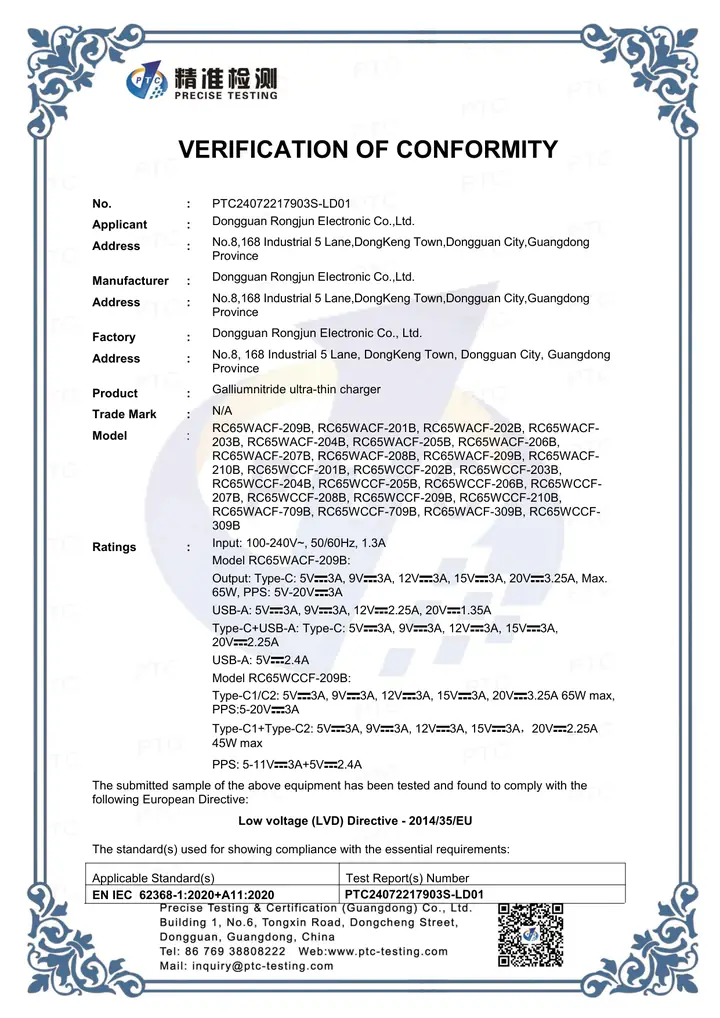
Ask for the first page of the CE (EN IEC 62368-1) or FCC test report for the exact model. It shows the applicant and the manufacturer. If the supplier you're talking to isn't on it, someone else made that charger. Our reports carry our own name, and you can see them on our certifications page.
The CCC certificate
ChineseCheck notes that some products need a production permit or compulsory certificate that only the real maker can hold. For chargers that's the CCC mark, China's compulsory certification. A CCC certificate names the applicant, the manufacturer and the production site. A trading company can't hold one for a factory's product in its own name as the producer. If the production site on the certificate is a different company, you've found the real factory.
Ask a question only an engineer can answer
"Which GaN switch and which PD controller does this model use?" A factory can answer from its bill of materials, usually the same day. A trader has to ask someone else and often comes back with something vague. The speed and the detail of the answer tell you a lot.
The shape of the product range
A charger factory's range is deep and narrow: different wattages, port layouts, plug types and housings of the same basic product. Ours runs from 30W to 140W in about a dozen models, all on our USB-C charger range page. A supplier showing chargers next to phone cases, earbuds, selfie sticks and kitchen scales is almost certainly buying from several factories. Easy Imex puts it simply: if the catalogue includes everything from electronics to rugs, it's a trading company.
The sample
ChineseCheck has a nice observation here. Factories often send existing samples free, because a sample costs them little compared with the order behind it. Traders usually pay the factory for samples, so they charge. We send one free sample per model, up to two models, ready in three days; you pay the courier. It isn't proof on its own, but it fits the pattern.
The address
Put the registered address into Baidu Maps or Google Maps and switch to the satellite view. A factory sits in an industrial area with big flat roofs and loading bays. Ours is No. 8, 168 Industrial 5 Lane, Dongkeng Town, Dongguan. An address on the 20th floor of a city-centre office tower is a sales office, not a production line.
The certificate itself
ChineseCheck warns that certificates get faked, and they're right. A PDF proves nothing on its own. A real test report has a report number and the name of the lab that issued it, and the lab can confirm it. Write to the lab with the report number and ask whether it belongs to that model and that company. It takes one email. Also check that the model number on the report matches the model on your quote exactly; a report for a 30W charger doesn't cover a 65W one.
Questions worth asking on the first call
Prestige Sourcing suggests testing the supplier's manufacturing knowledge rather than their sales pitch. For chargers, these questions sort people quickly:
- How long does each unit run in the aging test, and at what load?
- What voltage do you use for the hi-pot test, and is it every unit or a sample?
- What happens to a unit that fails? Is it scrapped or repaired and tested again?
- Which AQL levels do you use for final inspection?
- What flame rating does the housing material have?
A factory will answer these from the floor. For the record, our answers: every charger gets a hi-pot test and an aging test under load; a unit that fails is repaired and tested again on the spot; final inspection uses AQL with 0 critical, 0.65 major and 1.5 minor; the housings are flame-retardant V-0 PC. You don't need to know the right answers yourself. You need to notice whether the supplier knows them.
What a real factory video call shows
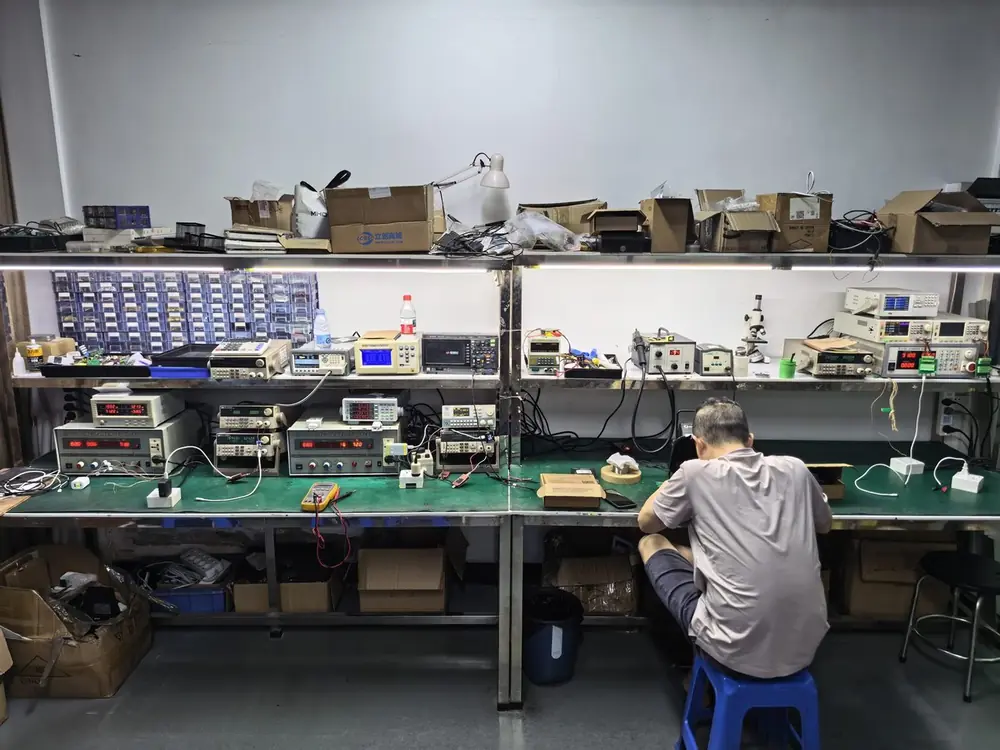
Prestige Sourcing and ChineseCheck both say the same thing: ask for a live walk-through, not a pre-recorded video, and ask questions while it's happening. Here's what you should be able to see on a charger factory call. It's also what we show people, and you can see the same rooms on our factory page.
- The SMT workshop, where the circuit boards are printed and populated.
- The DIP and assembly lines, where the transformers, plugs and housings go on.
- The aging zone, with racks of chargers running under load.
- The test stations for hi-pot and output checks.
- Packing, ideally with the exact model you asked about.
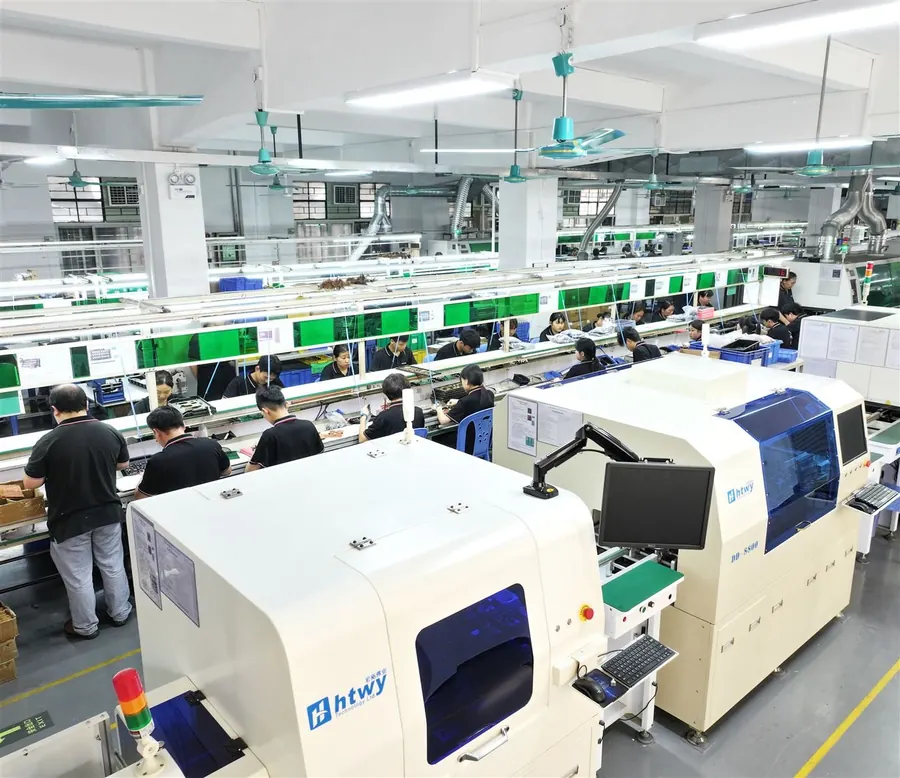
ChineseCheck warns about the next level of trick: a trader borrowing a partner's factory for one staged tour. Their counters are simple and they work. Call back an hour later and ask to see a different area. Ask someone on the line a question, not only the supervisor. And ask to see the business licence displayed on site; it should carry the same company name as your invoice.
Which parts does the factory actually make?
Statrys raises a point most guides skip: very few factories make every component themselves. That's true for chargers too, and it isn't a problem as long as you know who does what.
For our chargers, the boards are built on our own SMT line, then assembled, aged, tested and packed in our building. The chips (GaN switches, controllers), the USB-C connectors and the raw materials come from specialist suppliers, the same way they do for every charger brand you've heard of. So when we say we're the factory, we mean the place where the charger is put together, tested and signed off, and where the engineers who designed it sit.
Ask your supplier the same question: "Which steps happen in your building, and which parts do you buy in?" A factory answers that easily. A trader tends to answer "everything", which is never quite true.
Factories with a trading arm
Every competitor guide mentions this, and it causes a lot of confusion. Many genuine factories set up a second company to handle export sales or receive foreign currency. You might sign with the sales company while the goods come from the factory company. That's normal and fine.
What isn't fine is not knowing. Before you pay, ask three things: which company makes the goods, which company invoices you, and how they're connected. Then check that the bank account belongs to one of those two. Statrys adds a useful rule: the name on the contract, the invoice and the bank account should all match, or the link between them should be written down. If three different names show up with no explanation, stop and ask.
When a trading company is the better choice
Trading companies win plenty of orders, and often the buyer has made a sensible choice. A good trader is worth paying for when:
- You need several product types in one shipment. Chargers, cables, cases and packaging from four factories is real work. A trader does it for you.
- Your first order is below what factories accept. A trader can pool your order with others. You pay a little more per piece and get a smaller start.
- You have nobody to manage suppliers. If no one on your team can follow up daily, a trader's service has value.
- You're still testing the product. Before you know it sells, flexibility can matter more than the last few percent of price.
Statrys even points out that a trader adds its own quality check on top of the factory's. That can be worth something. Just know what you're paying for, and move closer to the factory once the product is proven and the volumes grow.
Red flags before you pay
| What you see | Why it matters |
|---|---|
| No business licence, or it arrives after a deposit | A licence is public. A factory sends it without fuss. |
| Scope says only sales, trade or import/export | The company isn't registered to make anything. |
| Address in an office tower | No room for a production line. |
| Test reports or CCC in another company's name | Someone else makes the product. |
| Factory photos you also find on other suppliers' sites | Stock or borrowed photos. A reverse image search shows it. |
| The live tour never happens, or only shows an office | A factory floor is easy to show on a working day. |
| Bank account name differs from the licence, unexplained | One of the most common signs of trouble. |
| Custom logo, colour and box at 50 pieces, bulk price | Below what a real line can carry. Ask how. |
One red flag can have an innocent explanation. Two or three together, and it's time to slow down. If you'd like to see what a charger factory looks like before you decide, here's a short clip from ours.
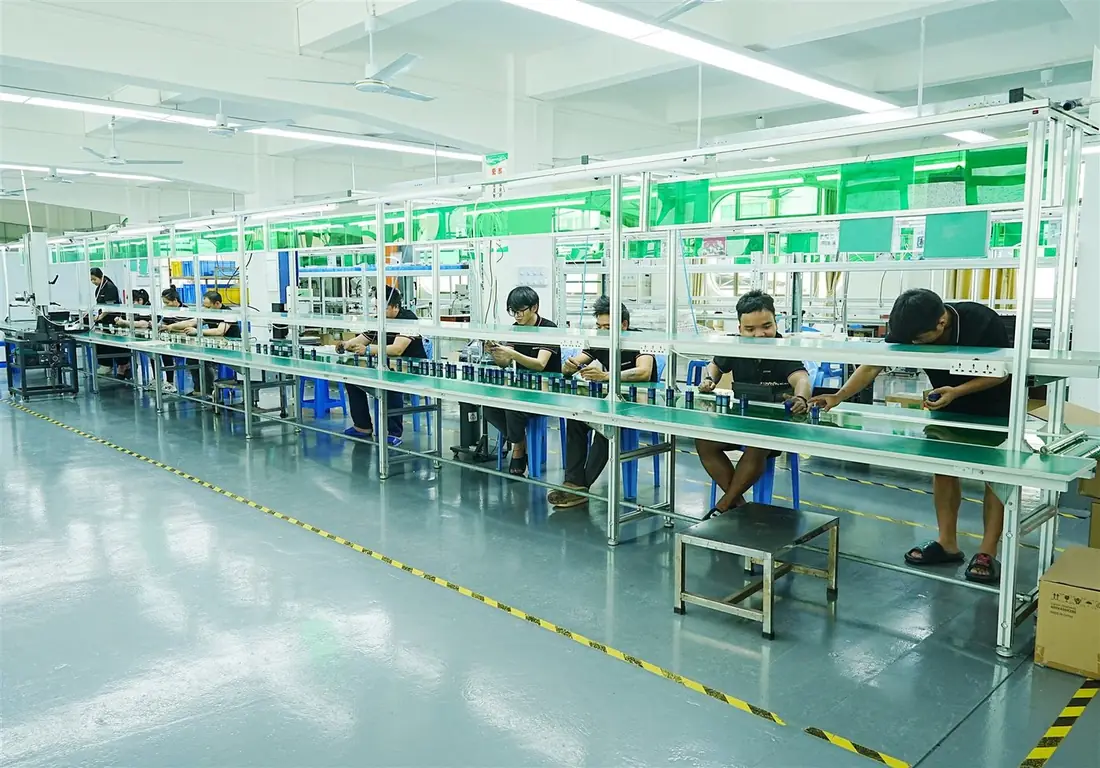
 Inside our Dongguan charger factory, 29 seconds
FAQ: factory vs trading company in China
What is the difference between a factory and a trading company in China?
Is it better to buy from a factory or a trading company?
How can I tell if an Alibaba supplier is a factory?
How much more does a trading company charge?
Can a trading company make a custom charger?
What is a CCC certificate and why does it help?
Do factories give free samples?
Can a company be both a factory and a trading company?
Should I visit the factory before ordering?
Is a trade fair booth proof of a factory?
How to avoid fake charger suppliers?
Want to check us the same way?
Ask for our business licence, our test reports or a live video tour of the line. We'll send them the same day, no deposit and no NDA needed.
Get a quoteMore from the Rongjun buyer's library
Our charger factory in Dongguan
Photos of the lines, the test equipment and the QC steps, with the address and visit details.
CE certified charger manufacturer
Our CE, FCC and RoHS documents, with our name as applicant.
Who makes Anker chargers?
What is public about big-brand suppliers, and what to check instead.